
Short answer: on VCF 9 hosts that run SAP HANA on NFS, give storage its own pair of physical NICs (vNICs on Cisco UCS), separate from vMotion. The VCF 9.1 Design Library’s 6‑NIC Storage and Workload Separation model does this and also isolates NSX workloads, so I recommend it as the baseline. The 4‑NIC Storage Separation model also isolates NFS storage, but it puts SAP client traffic on the same switch as vMotion. The reason is host maintenance. A vMotion of a 2 TB HANA VM lands on the same receive queues as the NFS log writes of every HANA database on that host, unless storage has a vNIC of its own. HANA commits wait for those log writes. A faster adapter does not change that, and VCF 9 makes it worse by allowing only one vMotion VMkernel adapter per host. You can watch all of it happen in an interactive model: vdan.cz/vcf9-sap-hana-tdi-design.
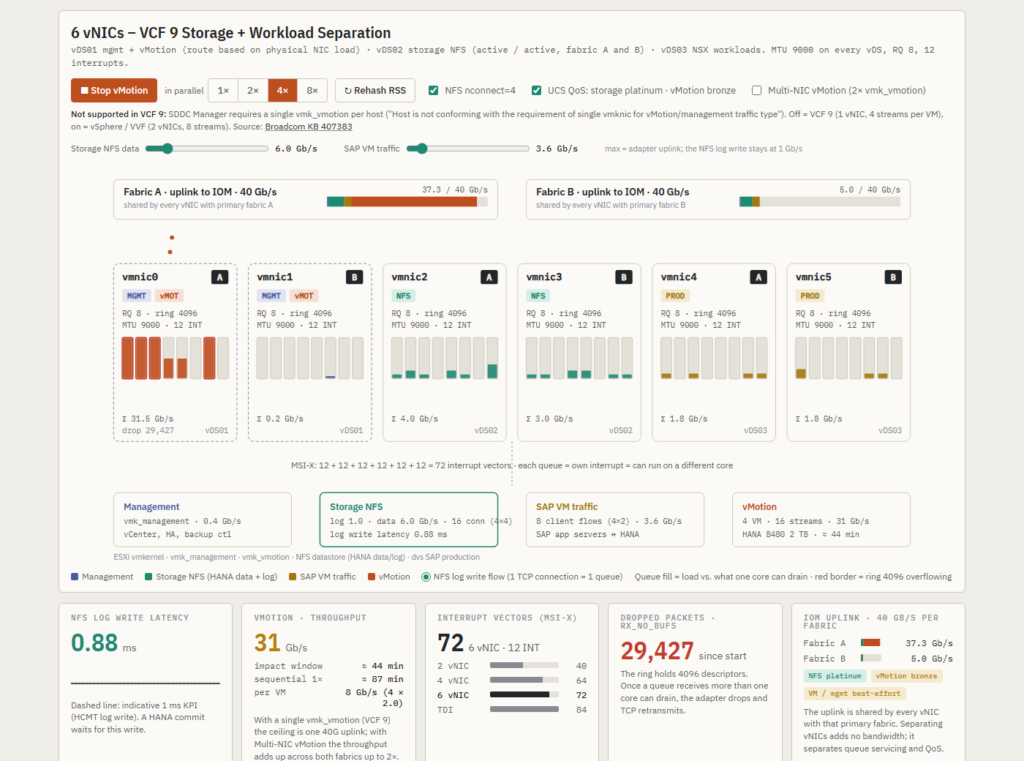
Why vMotion is a HANA problem and not just a network problem
HANA writes its redo log synchronously. A transaction commit returns only after storage has acknowledged the log write, so log write latency turns directly into application response time. The SAP HCMT tool checks this, and the indicative KPI for log write latency is about 1 ms. Under normal load a well built NFS path delivers a few hundred microseconds.
Now migrate a HANA VM with 1 to 2 TB of RAM. On a 40 Gb/s uplink a vMotion runs at 16 to 35 Gb/s for 10 to 20 minutes, including the dirty page iterations at the end. If that traffic shares the network path with storage, the log write latency jumps from sub‑millisecond to several milliseconds, commits stall, and the application servers see timeouts. This is why SAP and the FlexPod CVD separate vMotion from storage in the first place. The interesting part is where the sharing happens, because it is not only bandwidth.
What happens inside the adapter
On a Cisco UCS blade with a VIC, every vNIC in the service profile gets its own set of receive queues. The adapter policy used in the FlexPod TDI design gives each vNIC on a VIC 1380 8 receive queues with a ring of 4096 descriptors and 12 MSI‑X interrupts. On a VIC 15231 the policy is 16 queues, a ring of up to 16384 and 20 interrupts. Three details matter:
- The adapter spreads incoming flows across the queues with an RSS hash of IP addresses and ports. It does not know what a flow is. One NFS log connection always lands on exactly one queue.
- Each queue has its own interrupt and is serviced by one CPU core. A queue that receives more than its core can drain fills its ring and the adapter drops packets. That shows up as
rx_no_bufsinesxcli network nic stats. - Queues belong to the vNIC. Two vNICs on the same physical adapter never compete for queues or cores. They share only the uplink to the IOM or IFM, and that is where QoS can help.
So if vMotion streams and the NFS log flow arrive on the same vNIC, the hash will sooner or later put a vMotion stream on the queue that also carries the log write. Network I/O Control cannot see that. NIOC shares bandwidth between port groups on the uplink, it does not assign queues. Only a separate vNIC does.
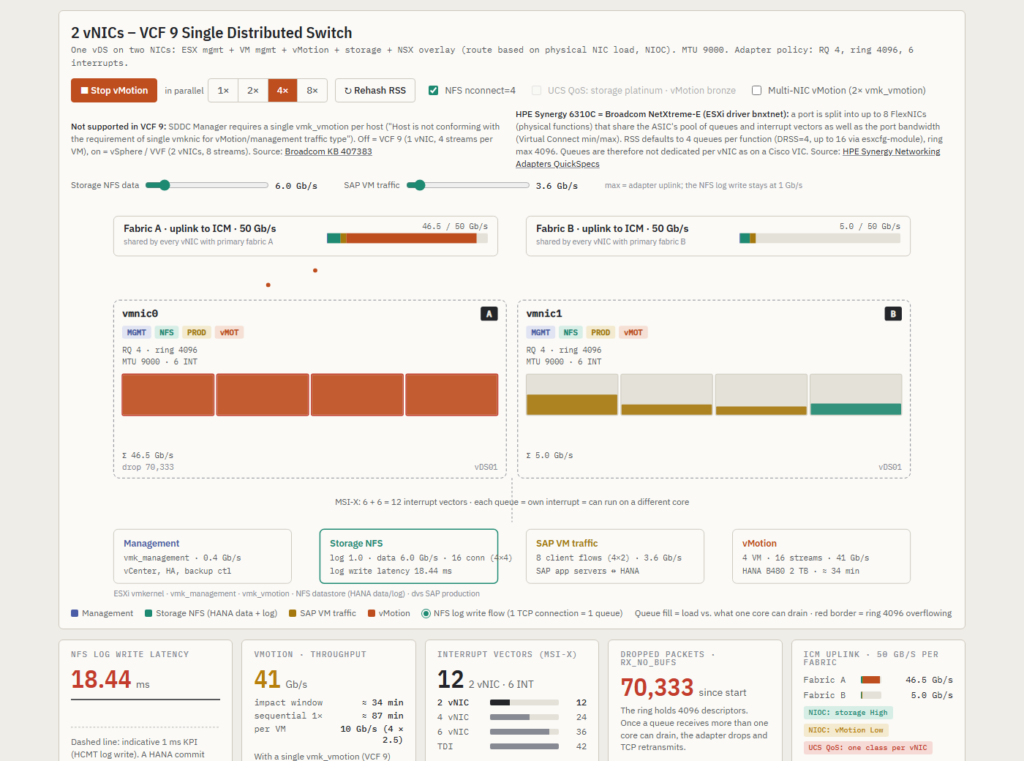
One remark for readers on HPE Synergy. The Synergy 6310C is a Broadcom NetXtreme‑E adapter (ESXi driver bnxtnet). A port is split into up to eight FlexNICs that share the ASIC’s pool of queues and interrupt vectors, and RSS defaults to 4 queues per function. A FlexNIC is still a separate function with its own RSS, so the storage FlexNIC does not receive vMotion packets, but the queues behind it are not dedicated in the way a Cisco VIC vNIC’s are, and there are fewer of them. The model treats it that way and I come back to it below.
The four layouts
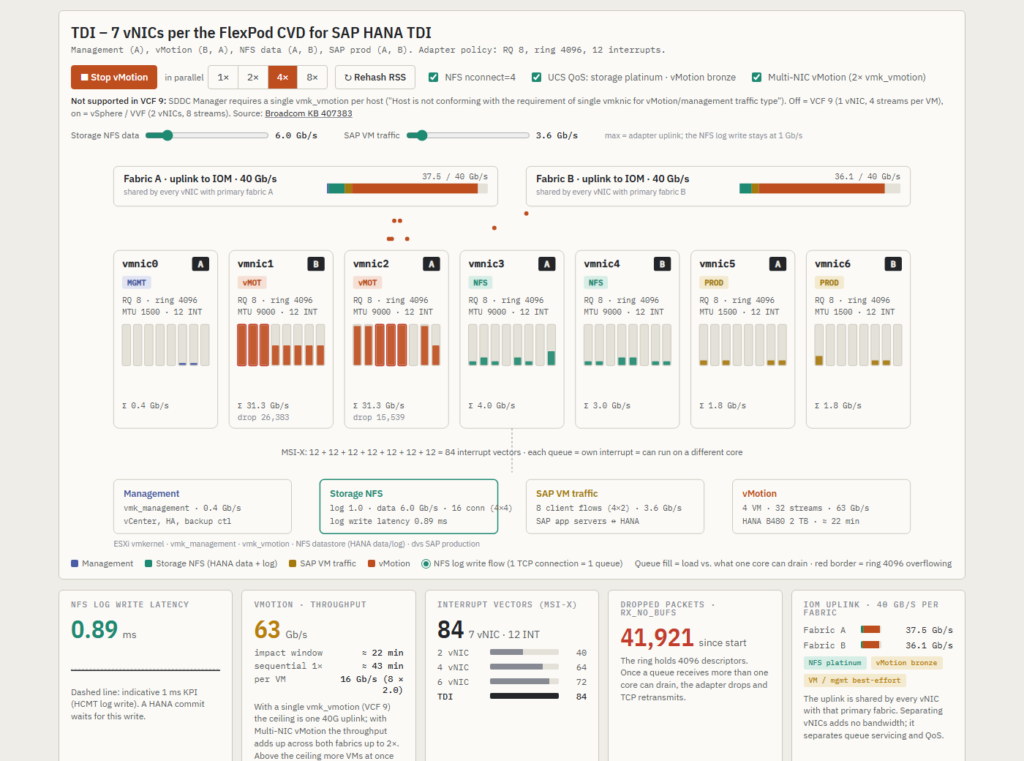
I modelled the three VCF 9.1 network models and the classic FlexPod TDI layout side by side. Same host, same VIC 1380 with 2 × 40 Gb/s, same traffic: NFS log 1 Gb/s, NFS data 6 Gb/s, SAP client traffic 3.6 Gb/s and management. Every HANA VM on the host mounts its data and log with nconnect, so it brings four NFS connections and two client flows of its own. The number of VMs is the parallel selector: with four VMs the storage class has 16 NFS data connections and the VM class 8 flows, with eight VMs 32 and 16. Then those one to eight HANA B480 VMs with 2 TB RAM are migrated at once. The VCF 9 rows use the single vMotion VMkernel adapter VCF 9 allows, the TDI row uses Multi‑NIC vMotion as the CVD configures it. The numbers are model output, not measurements. The model exists to show the mechanism.
| Layout | vNICs | Storage isolated from vMotion | Log write · idle | 1× vMotion | 4× vMotion | 8× vMotion |
|---|---|---|---|---|---|---|
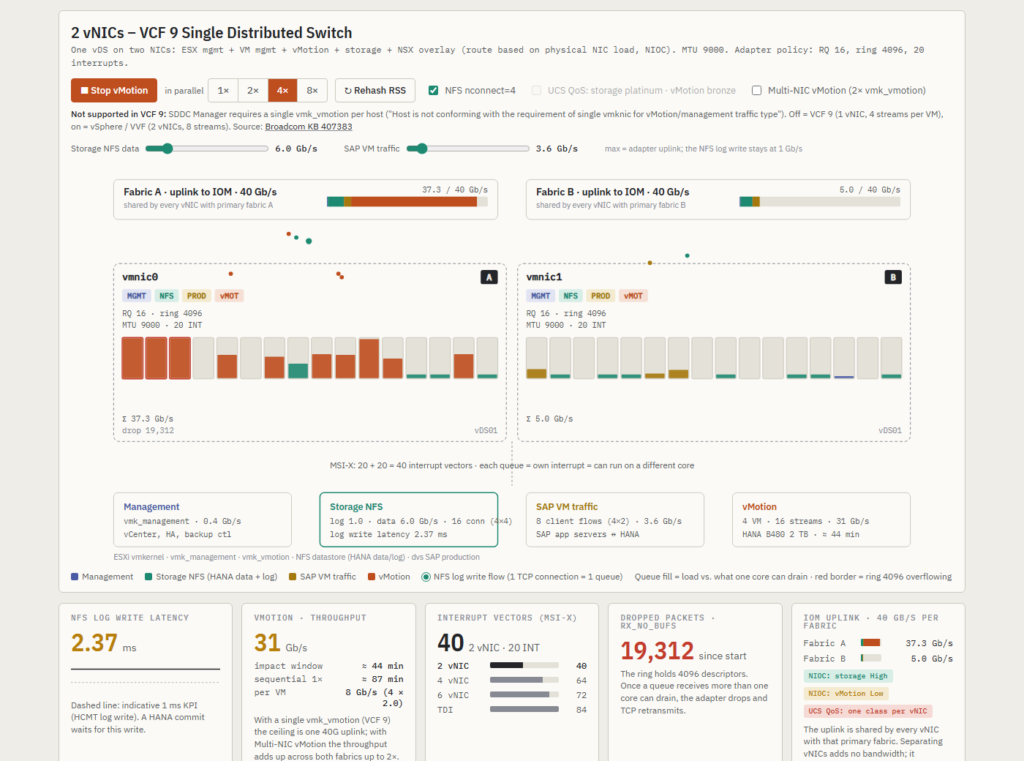
| VCF 9 Single Distributed Switch | 2 | no | 0.34 ms | 1.82 ms | 2.37 ms | 3.49 ms |
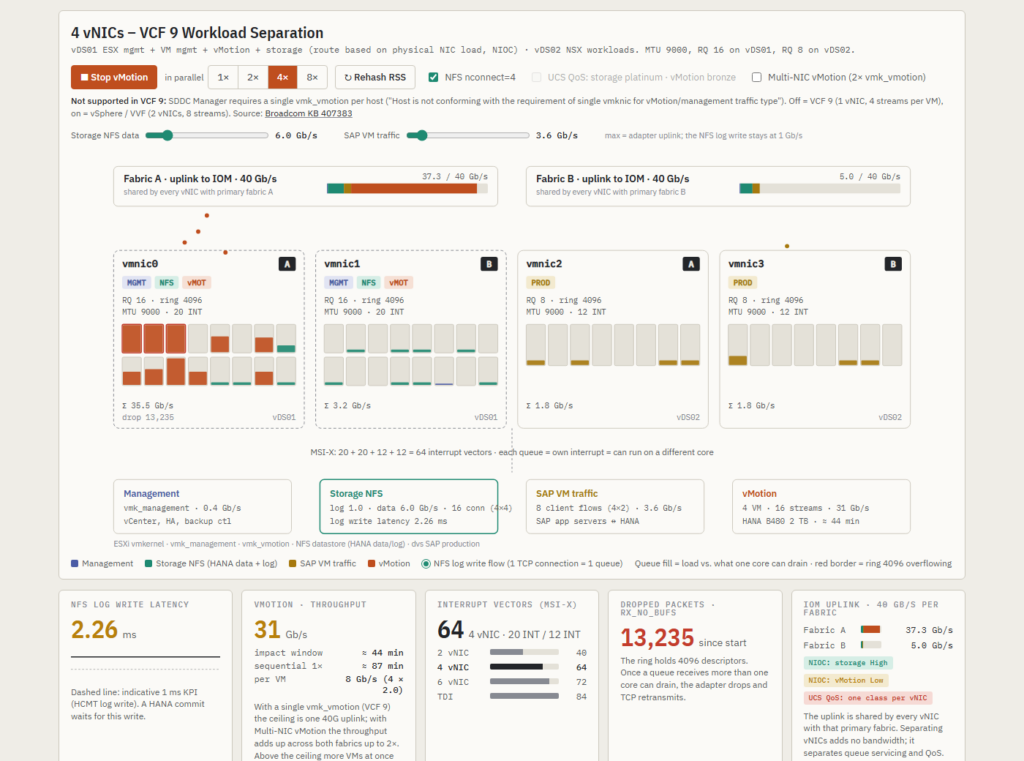
| VCF 9 Workload Separation | 4 | no | 0.34 ms | 1.82 ms | 2.26 ms | 3.49 ms |
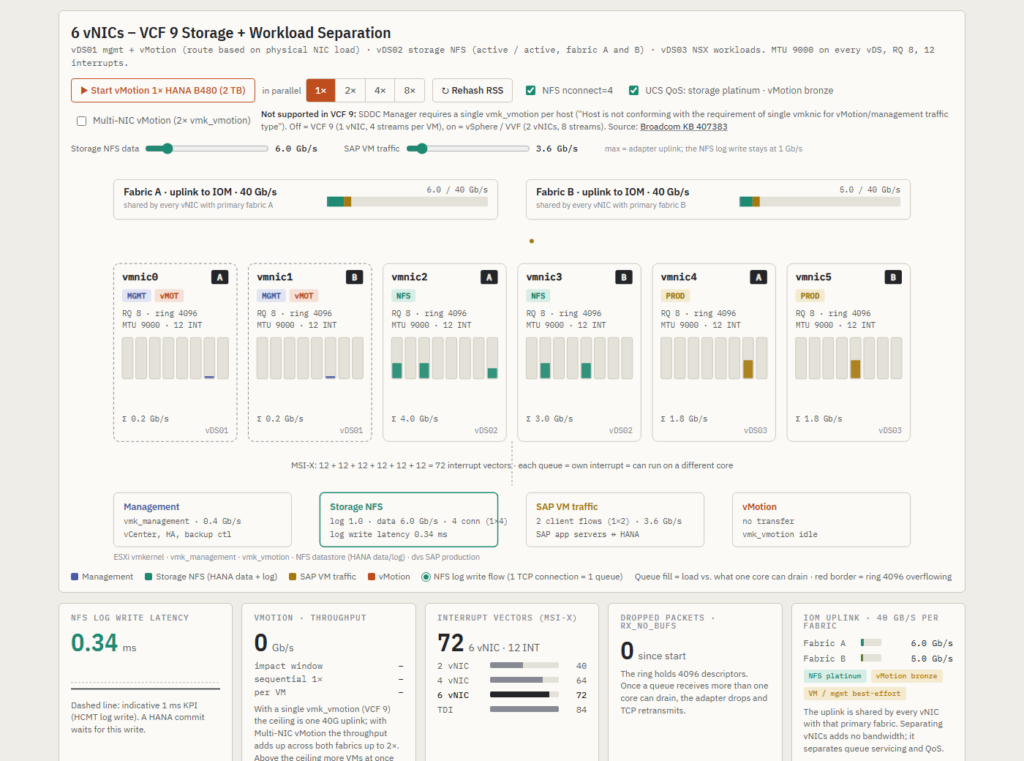
| VCF 9 Storage + Workload Separation | 6 | yes | 0.34 ms | 0.35 ms | 0.88 ms | 0.83 ms |
| FlexPod SAP HANA TDI (Multi‑NIC vMotion) | 7 | yes | 0.34 ms | 0.35 ms | 0.89 ms | 0.84 ms |
The split is clean. The two layouts that put vMotion and storage on the same vNIC cross the 1 ms KPI with a single migration. The two that give storage its own vNIC stay under it with eight. What remains in the 6 and 7 vNIC rows has two parts: uplink pressure, which is what the UCS QoS policy is for, and the fact that eight VMs bring 32 NFS data connections into the 16 storage queues, so the log flow starts sharing a queue with data connections of other databases. That second part is the argument for more queues on the storage vNIC, and I come back to it with the VIC 15231. The adapter policy values behind these queue counts are in VMware-v2 adapter policy for Cisco VIC.
2 NICs: Single Distributed Switch
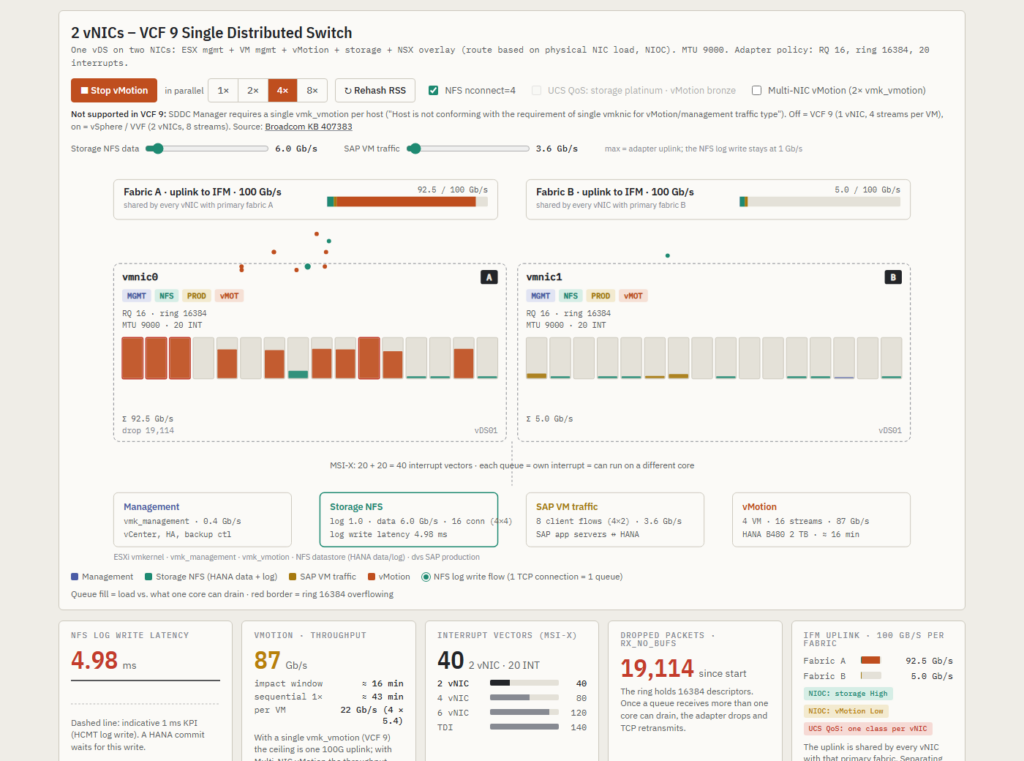
One vDS, everything on two uplinks, NIOC with storage and VMs at High and vMotion at Low, MTU 9000. It is the simplest model to run and the worst one for HANA. All four traffic classes hash into the same queues of the same vNIC. NIOC holds vMotion at the uplink limit, the queue collision remains.
4 NICs: Workload Separation
Two vDS. The NSX workloads get their own pair, which is good for the VMs. Management, vMotion and storage still share vDS01, so for the HANA log it changes almost nothing. The numbers are within hash luck of the 2‑NIC model. Note the greyed out QoS switch in the screenshot: UCS assigns a QoS class per vNIC, so storage and vMotion on one vNIC cannot be told apart on the uplink either.
4 NICs the other way: Storage Separation
The Design Library also has a 4‑NIC Storage Separation Distributed Switch Model. It uses the same two vDS as Workload Separation but splits them differently: one vDS is dedicated to storage, and the other carries everything else (management, vMotion and workloads). The Design Library lists it for NFS as well as vSAN, so it is a valid option for NetApp NFS datastores. I did not simulate this layout, so it has no row in the table. By the mechanism described above, it protects the HANA log write the way the 6‑NIC model does, because the storage vNICs never receive vMotion packets. It is still not the layout I recommend for HANA. The SAP application server traffic on the NSX segments now shares a vDS, its uplinks and its receive queues with vMotion, so every host evacuation affects the client path instead of the log. If a host has only four ports, Storage Separation is the better of the two 4‑NIC models, but plan for six.
6 NICs: Storage and Workload Separation
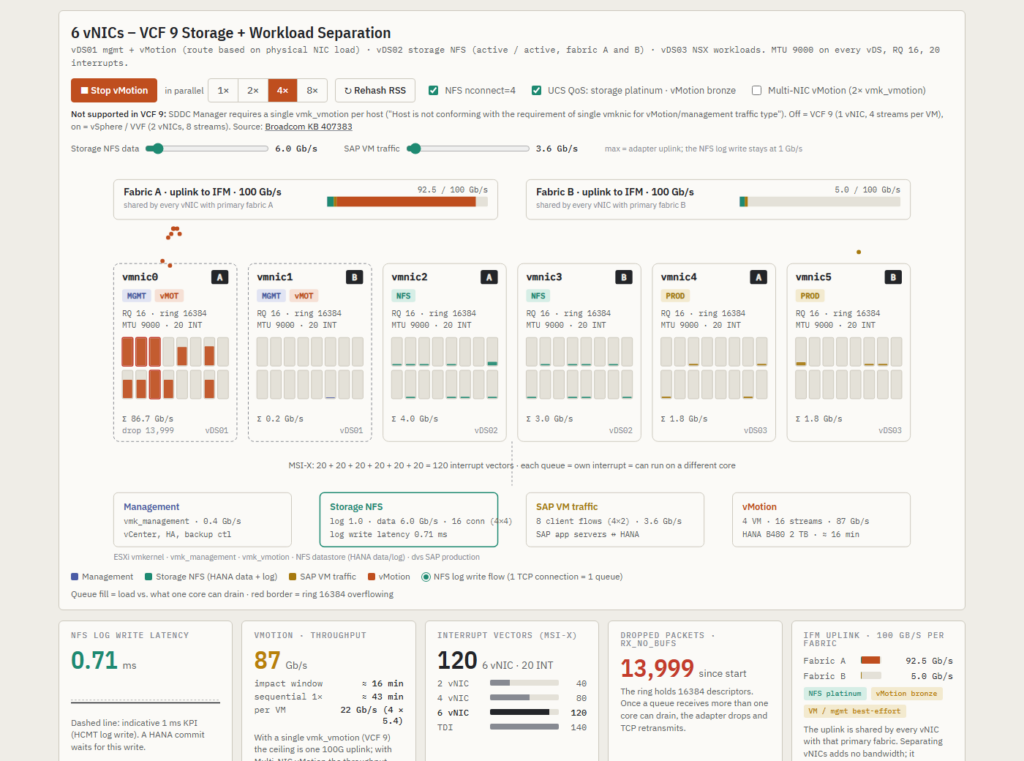
Three vDS on three NIC pairs. vDS01 carries management and vMotion, vDS02 carries storage on both uplinks active/active, vDS03 carries the NSX workloads. Storage now has its own pair of vNICs on both fabrics, its own queues and cores and its own UCS QoS class. vMotion shares a pair only with management, which is negligible traffic. The log write stays under 1 ms with eight parallel migrations. What moves the number from 0.35 to about 0.9 ms is not vMotion at all, it is the 32 NFS data connections of eight databases sharing 16 queues with the log flow. This is the layout I would make the baseline for any VCF 9 cluster that hosts HANA.
7 NICs: FlexPod SAP HANA TDI
The Cisco CVD layout goes one step further and gives management its own vNIC as well, and it runs vMotion with two VMkernel adapters on two vNICs. A 2 TB VM then migrates in about 11 minutes instead of 22. For the HANA log it behaves like the 6‑NIC layout, because the storage vNICs are separate either way. If you build on FlexPod without VCF, use it. If you build on VCF 9, the 6‑NIC model gets you the same protection for HANA with one vNIC template less.
QoS and NIOC are two different things
Separate vNICs alone are not enough. The uplink is still shared, and four parallel migrations will fill it. With a UCS QoS policy that puts the storage vNIC in the platinum class and vMotion in bronze, storage keeps its bandwidth and the log stays under 1 ms. Without it, vMotion takes the whole uplink and even the TDI layout ends up above 4 ms.

The reverse holds as well. NIOC on the 2 and 4‑NIC models does protect bandwidth, and the model gives it credit for that, but it cannot protect queues. You need both: a vNIC of its own for storage, and a QoS class of its own on the uplink.
Multi-NIC vMotion is currently not supported by VCF 9.x SDDC Manager workflows
On plain vSphere you would give vMotion two VMkernel adapters on two uplinks, so a migration can use both fabrics. vSphere and VVF support Multi-NIC vMotion, but VCF 9.x SDDC Manager requires exactly one VMkernel adapter tagged for vMotion per host. When a host has a second one, SDDC Manager flags it after an inventory sync with the message “Host is not conforming with the requirement of single vmknic for vMotion/management traffic type”. The fix is to remove the second adapter and re-run host commissioning. Broadcom KB 407383 describes the issue. It notes that hosts with multiple vMotion adapters reach far lower vMotion concurrency in VCF 9.x than in vSphere 8.x, and that Load-based Teaming on the single vMotion VMkernel adapter is the exception to that limit.
For HANA hosts this has two consequences. A single migration gets only half the stream helpers and one 40 Gb/s path, about 16 Gb/s in the model, so a 2 TB VM takes about 22 minutes instead of 11. And on the 2 and 4‑NIC layouts every one of those streams enters through the single vNIC that also carries the NFS log, which is why the table above shows the KPI broken from the first migration. The simulator has a Multi‑NIC vMotion switch so you can compare both cases. It is off by default because that is what VCF 9 gives you.
Parallel vMotion during maintenance
vSphere allows up to eight concurrent vMotions per host. With one vMotion adapter on a 40 Gb/s uplink, one 2 TB HANA VM uses about 16 Gb/s and takes about 22 minutes. Two in parallel fill the uplink at about 31 Gb/s and still finish in about 22 minutes, so the second one is free. From there on more parallelism buys nothing: four VMs take about 44 minutes and eight about 89 minutes, the same as running them two at a time. What grows is the impact window on the shared layouts, because every additional VM puts more vMotion streams into the queues the log flow lives in. When you evacuate a host with HANA VMs on VCF 9, two at a time is the sensible limit.
Does a faster adapter fix it?
The first question I got after showing the model was whether a 100 Gb/s adapter makes the discussion go away. The simulator now has three adapters to switch between: the Cisco VIC 1380 with 2 × 40 Gb/s, the Cisco VIC 15231 with 2 × 100 Gb/s and 16 receive queues per vNIC, and the HPE Synergy 6310C with 2 × 50 Gb/s. The table shows the 2 vNIC and 6 vNIC layouts on each, single vMotion adapter, UCS or NIOC bandwidth protection on.
| Adapter | Layout | Idle | 1× vMotion | 4× vMotion | 8× vMotion | 2 TB VM, one migration |
|---|---|---|---|---|---|---|
| Cisco VIC 1380 · 2 × 40G · RQ 8 | 2 vNIC | 0.34 ms | 1.82 ms | 2.37 ms | 3.49 ms | 16 Gb/s · ≈ 22 min |
| 6 vNIC | 0.34 ms | 0.35 ms | 0.88 ms | 0.83 ms | ||
| Cisco VIC 15231 · 2 × 100G · RQ 16 | 2 vNIC | 0.27 ms | 1.74 ms | 4.98 ms | 3.42 ms | 32 Gb/s · ≈ 11 min |
| 6 vNIC | 0.27 ms | 0.27 ms | 0.71 ms | 0.71 ms | ||
| HPE Synergy 6310C · 2 × 50G · RSS 4 | 2 vNIC | 1.81 ms | 3.92 ms | 18.44 ms | 40.17 ms | 16 Gb/s · ≈ 22 min |
| 6 vNIC | 0.34 ms | 0.34 ms | 0.87 ms | 0.87 ms |
The VIC 15231 halves the migration time and the wider ring drops far fewer packets, but on the 2 vNIC layout the log write still sits well above the KPI from the first migration. Bandwidth was never the only problem. The vMotion streams still land in the same queues and on the same cores as the log flow, and at 8 Gb/s per stream they fill a core faster than before. On the 6 vNIC layout the 15231 is better in every column, and the 16 storage queues per vNIC are exactly what the 32 NFS connections of eight databases need.
The Synergy 6310C is the other direction. With four RSS queues per FlexNIC, the 2 vNIC layout is above the KPI before any vMotion starts: the log flow of a single HANA VM already shares its queue with NFS data and client traffic. Every migration then lands in the same four queues, and at four and eight migrations the model’s latency formula runs off the scale, so take the direction from those cells and not the digits. The 6 vNIC layout still protects the log, because the storage FlexNIC never sees vMotion packets, but the headroom is smaller than on either VIC. If you run HANA on Synergy, raise the RSS queue count of the storage function from the default and give storage its own FlexNIC pair in Virtual Connect with a bandwidth minimum.
Lifecycle note for the VIC 1380: Broadcom KB 391170 lists the UCS VIC 1340 and VIC 1380 as Restricted in ESX 9.0, under both nenic and nfnic. They still work on 9.0 and stay listed in the compatibility guide, but they get no new features or driver enhancements and only best-effort fixes, and Restricted devices are removed in the next major release. The VIC 15231 isn’t in either the Restricted or the End of Life list. If you are planning new HANA hosts for VCF 9, start from the 15231, and check your exact adapter and firmware in the Broadcom Compatibility Guide. The full list is on ESXi 9.0 – Deprecated and unsupported devices.
What I recommend
- For HANA hosts on VCF 9, use the 6‑NIC Storage and Workload Separation model. If a host has only four ports, Storage Separation is better than Workload Separation because it keeps the NFS log away from vMotion, but SAP client traffic then shares the path with vMotion, so plan for six. On FlexPod without VCF, keep the 7‑vNIC TDI layout from the CVD.
- Put the storage vNICs in a platinum QoS class in UCS and vMotion in bronze. NIOC is not a substitute on the uplink, and it is no help at all in the queues.
- Do not buy a faster adapter to avoid the layout decision. A VIC 15231 shortens the maintenance window, it does not separate the queues. Where it does pay off is the storage vNIC: 16 queues for the NFS connections of many databases on one host.
- Mount HANA data and log with nconnect, or with several mounts. One TCP connection is one queue and one core. Count the connections: eight databases with nconnect=4 are 32 data connections plus their log flows on the storage vNIC.
- Limit concurrent HANA vMotions per host to two during maintenance windows. With the single vMotion adapter VCF 9 allows, two migrations fill the uplink and a third one only stretches the window.
- Run HCMT at idle and during a vMotion of one and two HANA VMs, and keep the result as a baseline. On a performance ticket SAP and Broadcom ask about deviations from best practice first.
- Watch
rx_no_bufson the storage vNICs. If the counter increases during the test, the receive ring is being exhausted. Correlate this with per-queue statistics and traffic load before attributing the drops to RSS/queue contention.
Try it yourself
The interactive model is on this site: vdan.cz/vcf9-sap-hana-tdi-design. You can switch between the four layouts and the three adapters, set one to eight HANA VMs and migrate them in parallel, toggle the UCS QoS policy, nconnect and Multi‑NIC vMotion, move the NFS data and SAP client traffic sliders up to the adapter’s line rate, and re‑roll the RSS hash to see how much of the effect is luck. The numbers update live, including the log write latency, the number of NFS and client connections per layout, the interrupt vector count and the dropped packets on the rings. It is available in Czech and English.
A word on the model: queue capacity, stream rates and the latency formula are illustrative and documented on the page. They are there to explain why the layouts behave differently, not to replace a measurement on your own hardware.
Related on vdan.cz
- Support for nConnect in the ESXi NFS client
- Multiple-NIC vMotion tuning on 2 × 40 Gb/s
- vSphere 9 and VCF editions comparison
- SAP HANA on VCF 9: TDI network design and vNIC simulator (the interactive model behind this post)
- VMware-v2 adapter policy for Cisco VIC: RX queues, ring size and RSS values
- SIOC deprecation and removal in vSphere 9: why storage isolation moves to the network layout
- How to check VCF 9 hardware compatibility
- NSX Edge design on Cisco UCS for NSX 4.x and VCF 9
Sources
- VCF 9.1 Design Library: Single Distributed Switch Model
- VCF 9.1 Design Library: Workload Separation Distributed Switch Model
- VCF 9.1 Design Library: Storage Separation Distributed Switch Model
- VCF 9.1 Design Library: Storage and Workload Separation Distributed Switch Model
- Cisco CVD: FlexPod Datacenter with Cisco UCS for SAP HANA TDI
- SAP HANA on vSphere Best Practices
- Broadcom KB 407383: Host is not conforming with the requirement of single vmknic for vMotion/management traffic type
- HPE Synergy Networking Adapters QuickSpecs
