I am always on the lookout for new and interesting hardware platforms that can benefit the VMware Homelab Community. In the month of January, there were a number of new announcements that I had been following including news from the Computer Electronic Show (CES) but also a couple of product releases from vendors that I […]
Boot ESXi from a RAID 1 M.2 volume on Cisco UCS-M2-HWRAID: controller limits, UCS Manager, Intersight and CIMC steps, and ESXi 8/9 boot device rules.
Short answer: UCS-M2-HWRAID is Cisco’s boot-optimized M.2 RAID controller for UCS M5 and M6 servers. It holds two identical M.2 SATA SSDs and supports only RAID 1 or JBOD (default JBOD). It boots only in UEFI mode, and one virtual drive always uses the full capacity. To boot ESXi, create a RAID 1 LUN in UCS Manager, Intersight or CIMC, set a UEFI boot policy to local disk (MSTOR-RAID), and install ESXi to that volume.
What is UCS-M2-HWRAID
The Cisco Boot-Optimized M.2 RAID Controller (PID UCS-M2-HWRAID) is a module that plugs into the mini-storage connector on the motherboard. It has two slots for SATA M.2 SSDs and an integrated 6 Gbps SATA RAID controller. In UCS Manager, Intersight and CIMC the controller shows as MSTOR-RAID. Its job is to give ESXi a mirrored local boot device without using the front drive bays or an SD card.
Property
Value (Cisco documentation)
Servers
UCS C220 M5, C240 M5, C480 M5, B200 M5, B480 M5 (UCS Manager 4.1 guide); also required for M.2 SATA on C220 M6 (spec sheet)
Minimum firmware
UCS Manager 4.0(4a) for the RAID procedure (tech note); Cisco IMC / UCS Manager 4.2(1) on M6
M.2 drives
240 GB and 960 GB SATA M.2 (UCSM 4.1 guide); C220 M6 spec sheet lists UCS-M2-240G, UCS-M2-480G, UCS-M2-960G
RAID levels
RAID 1 or JBOD only (default JBOD)
Boot mode
UEFI only; legacy boot not supported
Virtual drives
One, using the entire disk capacity
Mixing drives
Not supported (use two identical SSDs)
Hot-plug
Not supported; power the server off to replace a drive (M6 spec sheet)
Other UCS Manager limitations: the Local Disk Configuration policy is not supported, the LUN must be created in the Local LUNs tab of a storage profile (not with controller definitions), and existing LUN migration is not supported.
UCS-M2-HWRAID in UCS Manager: create the RAID 1 boot LUN
These screenshots are from my UCS Manager setup.
1. Disk group policy: Storage > Storage Policies > root > Disk Group Policies
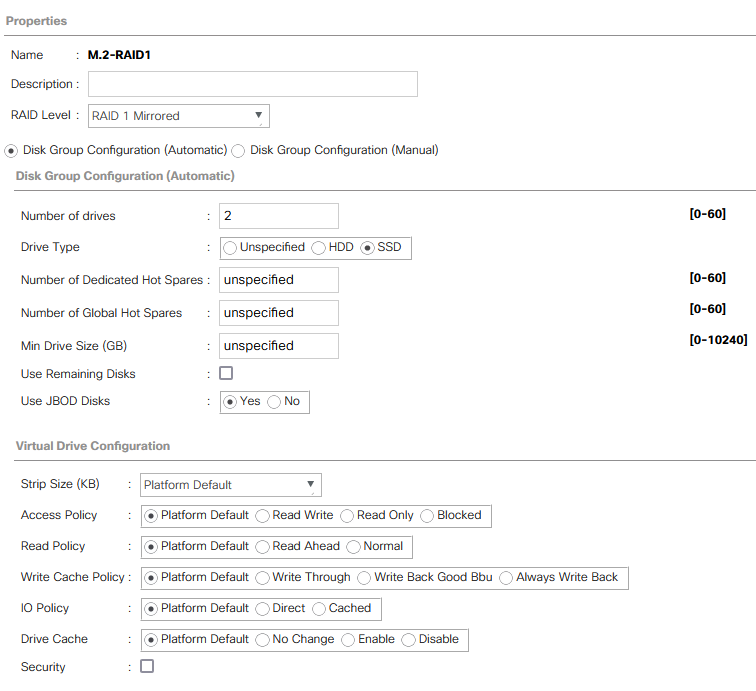
Create a policy (here M.2-RAID1) with RAID Level RAID 1 Mirrored, 2 drives, drive type SSD.
If the service profile association fails with Server does not fulfill Local Disk config requirements, Cisco’s tech note says to use Disk Group Configuration (Manual) with the two M.2 slots and to disable pSATA. With manual configuration, leave the span ID unspecified and set the disk role to normal.
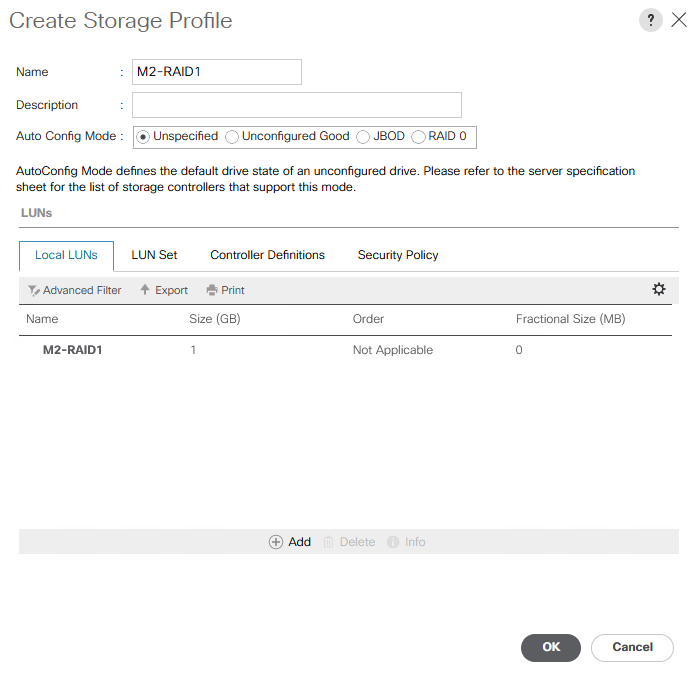
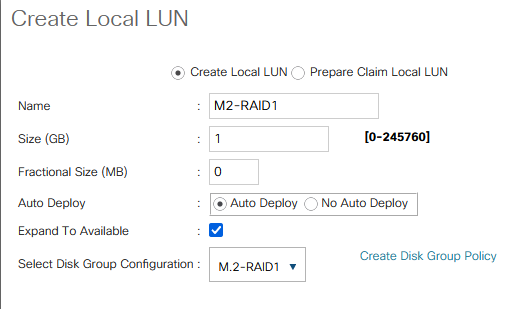
Add a local LUN, select the disk group policy and enable Expand To Available. The controller supports only one LUN over the whole mirror anyway.
4. Attach the storage profile to the service profile
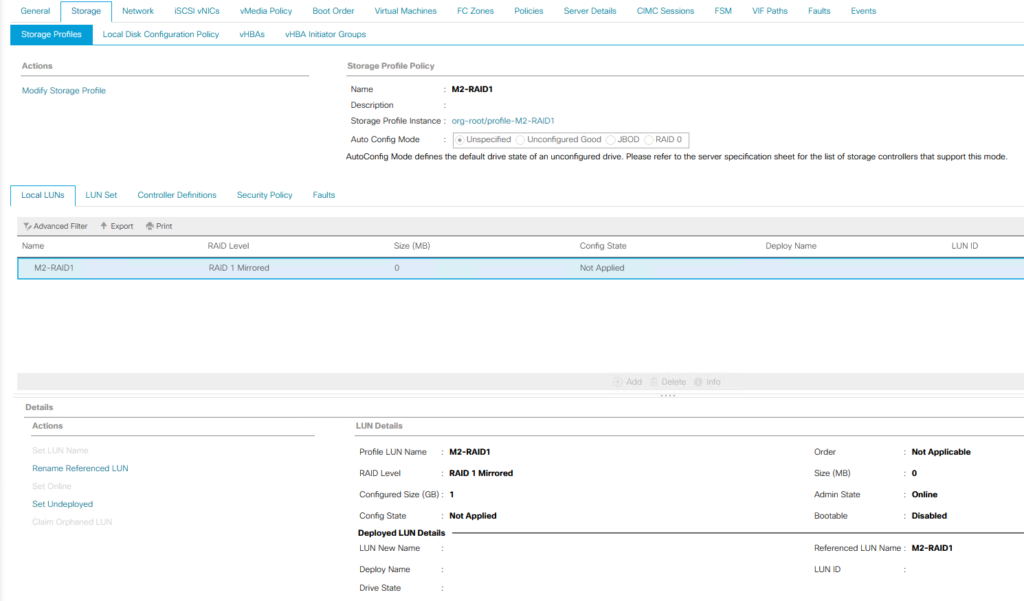
In the service profile, open Storage > Storage Profiles > Modify Storage Profile and select the profile. The LUN shows Not Applied until the profile is associated.
5. Boot policy: UEFI, Local Disk first
Use a boot policy with boot mode UEFI (the controller does not boot in legacy mode) and put the local disk first.
UCS-M2-HWRAID in Intersight Managed Mode
Create a Storage policy and enable M.2 RAID Configuration. Keep the default virtual drive name MStorBootVd or set your own. Select the M.2 controller slot: MSTOR-RAID-1 for C-Series and X-Series. Only the B200 M6 can have a second controller (MSTOR-RAID-2).
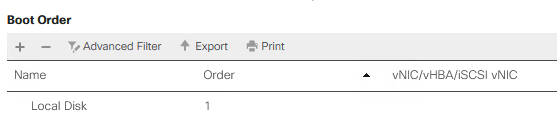
Create a Boot Order policy (Policies > Create Policy > UCS Server > Boot Order) in UEFI mode. Add Local Disk with the slot set to the M.2 controller from the server inventory (MSTOR-RAID), then add virtual media for the installer.
Add both policies to the server profile and deploy it. The RAID 1 volume should be visible in the ESXi installer.
UCS-M2-HWRAID in standalone CIMC
Storage > Cisco Boot optimized M.2 Raid controller (MSTOR-RAID). In Physical Drive Info, check that both drives are healthy.
Create Virtual Drive from Unused Physical Drives, move both M.2 drives to the drive group, choose RAID 1 (the only option on this controller) and click Create Virtual Drive.
Compute > Configure Boot Order > Advanced. Add Local HDD with slot MSTOR-RAID, or use Add Embedded Storage.
Without CIMC access, the same controller menu is in BIOS setup: press F2 during POST, then go to Advanced > Cisco Boot optimized M.2 RAID Controller.
UCS-M2-HWRAID ESXi driver and support
Cisco does not ship a separate ESXi driver download for this controller in the documents above. Whether a given ESXi release is supported on your server with this controller is defined by the Cisco UCS Hardware and Software Compatibility tool (ucshcltool.cloudapps.cisco.com) and the Broadcom Compatibility Guide. Check both for your exact server, firmware bundle and ESXi build before you upgrade. Install from the Cisco custom ESXi ISO so that the Cisco drivers match the firmware.
After installation, confirm which driver ESXi bound to the controller, and that the boot device is the RAID volume:
esxcli storage core adapter list
esxcli storage core device list
ESXi 7, 8 and 9 boot device requirements
Broadcom KB 317631 (formerly 85685, “SD card/USB boot device revised guidance”) is the reference for boot media. A RAID 1 M.2 SATA SSD volume is exactly the kind of local persistent boot device it recommends:
Requirement
ESXi 8.x
ESX 9.x
Boot device size
32 GB minimum, 128 GB recommended
128 GB minimum
Endurance
128 TBW over 5 years
IO performance
At least 100 MB/s
Media
PCIe NVMe, SAS, SATA/SATADOM SSD; industrial-grade flash (SLC or pSLC)
SD card / USB
Still supported through VCF 9.0 on previously certified servers, but not recommended; new platforms are not certified with SD/USB boot
Every M.2 size listed above (240, 480 or 960 GB) meets the ESX 9 minimum of 128 GB. Check the endurance rating of your specific SSD model against the 128 TBW requirement. On ESXi 7.x, SD cards can still hold all partitions, but Broadcom strongly recommends moving to a persistent device. If you are replacing SD cards on M5/M6 servers, UCS-M2-HWRAID is the natural choice.